


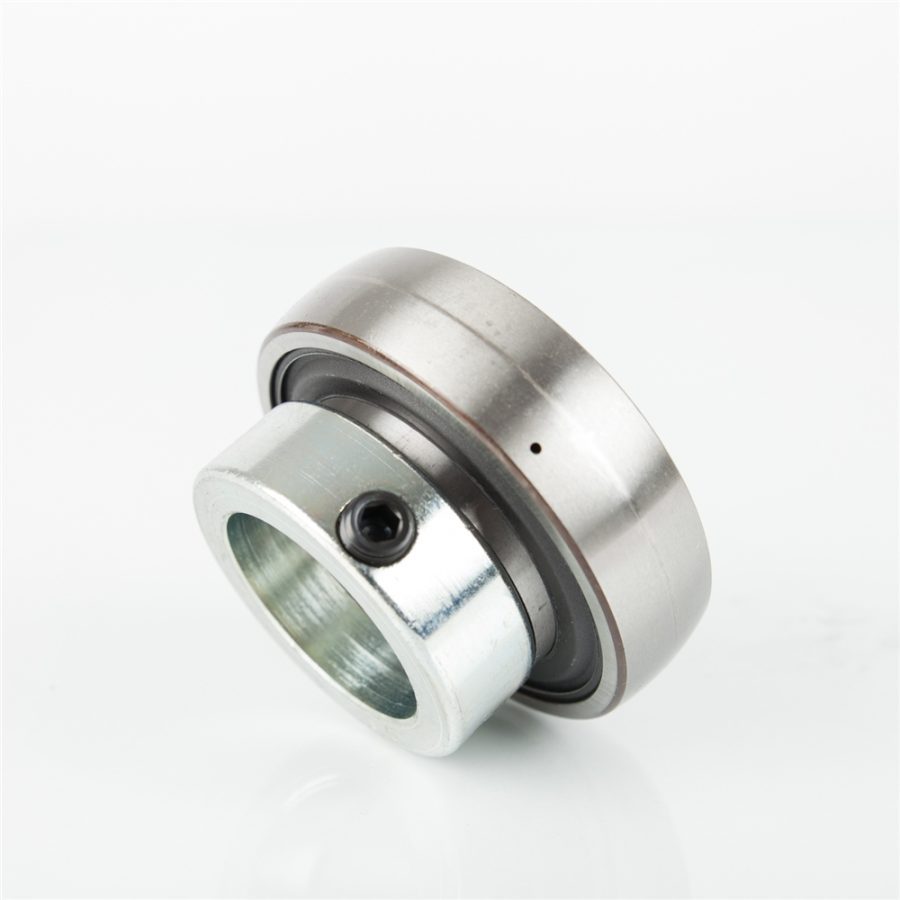
Because of their simplicity, versatility, and convenience of installation, insert bearings are among the most popular bearing configurations in commercial and industrial machinery. Insert bearings are made to be fitted directly into a range of pre-formed housings, greatly simplifying the surrounding mechanical assembly, in contrast to standard rolling element bearings that need to be pressed into machined housings with precise dimensional tolerances. For engineers, maintenance personnel, and procurement specialists, it is crucial to comprehend how these components function, where they are utilised, and how to choose the appropriate unit for a certain application.
Similar to a traditional deep groove ball bearing, insert bearings such as the SKF YET207 are made up of an inner ring, an outer ring, rolling elements, and a cage. On the other hand, an insert bearing’s outer ring is usually spherical. Small degrees of angular misalignment between the shaft and the housing can be accommodated by the bearing’s ability to self-align within a corresponding concave seating in its housing thanks to its convex outer surface. This self-aligning capability is a distinctive feature, and it is one of the key reasons that insert bearings are so extensively specified across difficult situations where exact shaft alignment cannot always be ensured. For instance, the 35mm bore insert bearing SKF YET207 is a popular choice in many mechanical systems because it combines this self-aligning outer ring shape with strong seals and a shaft locking mechanism.
The term “extended inner ring” refers to the fact that the inner ring of the majority of insert bearings is wider than the outer ring. The locking mechanism, which fastens the bearing to the rotating shaft, uses this enlarged part as its contact surface. The industry uses two typical locking techniques. One or two harder screws are tightened through the inner ring and onto the shaft surface in the first type of screw arrangement, known as a grub screw or set screw. The second is an eccentric locking collar, which is a sleeve that produces a tight interference fit by rotating against the direction of shaft rotation. Engineers have options when constructing or replacing components in an existing system because the SKF YET207 is available in configurations compatible with both approaches, each of which has advantages according on the application.
Another crucial component of insert bearing design is sealing. Effective sealing is crucial to service life since these bearings are frequently employed in settings where contamination from dust, moisture, or chemical splatter is a serious concern. The majority of contemporary insert bearings, such as the SKF YET207, come pre-greased and have contact seals installed on both sides. These seals keep oil inside the bearing chamber while preventing impurities from entering. For most common applications, the integrated seals of a unit like the SKF YET207 are more than enough to protect the rolling elements during the anticipated service interval. However, additional external sealing arrangements may be added at the housing level in extremely harsh environments.
Over the years, there has been a significant evolution in the materials utilised in insert bearing construction. Usually, premium bearing steel that has been hardened and machined to exact tolerances is used to make the rolling elements and rings. Depending on the operating conditions, the cages that guide and divide the rolling parts might be formed of polymer materials or pressed steel. There are stainless steel variations that provide improved corrosion resistance for uses involving moisture, food preparation, or chemical exposure. However, normal bearing steel with treated seals is used in the standard SKF YET207, which is perfectly suitable for a variety of general-purpose industrial and agricultural applications.
Conveyor systems are among the most popular uses for insert bearings. Conveyors rely on spinning shafts supported at various intervals, whether they are handling baled items in an agricultural environment, moving packages through a distribution center, or conveying aggregates on a construction site. These shafts can be supported fast and affordably without the requirement for properly bored housings thanks to insert bearings installed in pillow block or flanged housings. In precisely this situation, the SKF YET207 is widely utilised, offering dependable support for shafts in tail-end rollers, tensioning assemblies, and conveyor drives when sporadic angular misalignment is anticipated.
Another significant application industry is agricultural machinery. Numerous rotating shafts found in spreaders, balers, seed drills, and combine harvesters must all operate dependably in unclean, vibration-prone settings. The SKF YET207 is especially well-suited to this environment because of its strong sealing and self-aligning capability. The spherical outer ring of the bearing automatically adjusts when a baler or spreader shaft deflects slightly under pressure, preventing harmful edge loading on the rolling elements. When compared to rigid bearing arrangements in the same application, this misalignment tolerance can significantly increase service life.
A number of factors must be carefully taken into account when choosing the appropriate insert bearing for a particular application. The most important consideration is shaft diameter, and insert bearings come in a variety of bore sizes to fit shafts with both metric and imperial measurements. With a bore diameter of 35 millimetres, the SKF YET207 is in the middle of the regularly available insert bearing sizes. The engineer must take into account the direction and size of applied loads in addition to bore size. Although they can withstand mild axial stresses, insert bearings in the Y-bearing family, of which the SKF YET207 is a part, are primarily built to handle radial loads. Other bearing types can be more suitable for applications with substantial axial loading or mixed load profiles.
Another important consideration is speed capability. In general, insert bearings are not high-speed parts. When contrasted to precision deep groove ball bearings in high-speed spindle applications, the locking mechanisms, extended inner rings, and seals all present limits. However, the SKF YET207 and comparable units function satisfactorily within their claimed speed limits for most of the shaft speeds seen in conveyor drives, fan assembly, pump shafts, and agricultural equipment. It is simple and should always be a part of the selection process to consult the bearing’s technical data to confirm that the application’s operating speed is below the stated limiting speed.
One of the reasons insert bearings are so widely used is that replacement and maintenance are usually simple. Regular re-lubrication is frequently not required during the service interval because the bearing is pre-greased and sealed, as long as the seals stay intact. When a bearing needs to be replaced, the procedure usually entails cleaning the housing seating surface, removing the old unit from the housing, loosening the shaft locking mechanism, and fitting the new bearing. Like the majority of insert bearings in its class, the SKF YET207 may be replaced in many installations without dismantling the surrounding shaft assembly, thus decreasing downtime in production settings.
It is important to comprehend how the housing and bearing work together in a full insert bearing unit. The housing, which might be a take-up frame, flanged unit, or pillow block, offers the concave spherical seating that takes the bearing’s outer ring. Usually, either cast iron or pressed steel is used for the housing; in heavier-duty applications, cast iron is favoured because of its increased rigidity. The bearing and housing are designed to work together as a matched assembly, and specifying a housing with a seating diameter sufficient for the SKF YET207 ensures that the correct contact geometry is maintained between the outer ring and the housing bore. The self-aligning advantage can be negated and wear can be accelerated if the bearing is used in an improperly sized or worn housing.
In conclusion, insert bearings play a significant role in the mechanical component environment. They are a useful and affordable option for a wide range of applications because to their self-aligning capability, pre-lubrication, integrated sealing, and simple installation. As a representative unit in this product family, the SKF YET207 exemplifies the essential design features that have made insert bearings such a durable option in industrial and agricultural machinery. Anyone dealing with rotating machinery would benefit greatly from knowing how insert bearings work and how to choose them appropriately, whether the task is supporting a conveyor shaft, a fan drive, a pump, or a piece of field equipment.