

The Goddess You Carry With You
You’ve probably seen her before. Serene face. Flowing robes. Maybe holding a vase. Maybe standing on a lotus. Her presence is soft, yet powerful—like a whisper that somehow fills a room. That’s Kuan Yin.
Over the centuries, she’s become one of the most beloved figures in Eastern spirituality. Also known as Guanyin, Quan Âm, or the Goddess of Mercy, she appears in temples, homes, and yes—jewelry.
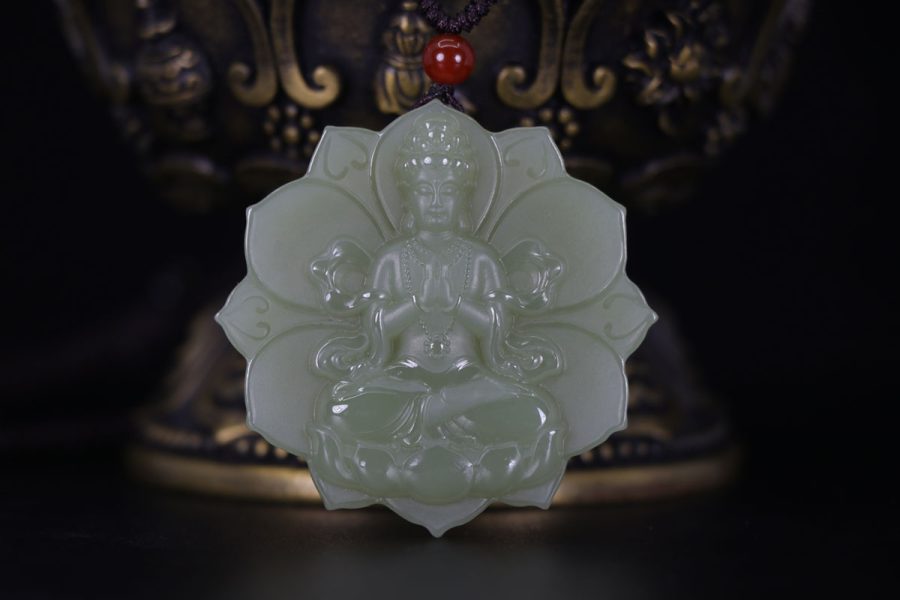
At first glance, a pendant bearing her image might just seem beautiful. However, when you see her image hanging around someone’s neck, it’s not just for beauty. That pendant carries something ancient. Something sacred.
So if you’ve ever wondered what it means to wear a Kuan Yin pendant, you’re in the right place. In the paragraphs ahead, let’s explore the story, the symbolism, and the soul behind it.
Who Is Kuan Yin, Really?
Kuan Yin or Guanyin isn’t just a deity. She’s an embodiment of compassion in human form. Within the teachings of Mahayana Buddhism, she’s a bodhisattva—a being who could have reached enlightenment but chose to stay behind to help the rest of us. That alone sets her apart.
Her name, in essence, translates to “She Who Hears the Cries of the World.” And that’s exactly what she does—listens. To pain. To prayers. To heartbreak. She doesn’t judge. She doesn’t punish. Instead, she simply shows up, offering mercy like an open hand.
Across time and geography—from China to Japan to Vietnam—Kuan Yin is loved not because she’s powerful, but rather because she’s kind. Her strength is tenderness. Her wisdom is patience.
Consequently, that’s why her pendant means so much more than just jewelry.
A Symbol You Wear on Your Chest
When people wear a Kuan Yin pendant, they’re not just accessorizing. They’re aligning. In other words, it’s a way of saying, “I want to walk with compassion.” Not just believe in it, but also live it.
The pendant often rests close to the heart. That’s no accident. By its very placement, it becomes a guardian. A comfort. A quiet reminder to stay soft in a world that can feel so hard.
Moreover, for many, it’s more than symbolic. It’s protective. In fact, some believe Kuan Yin watches over those who wear her image. That she shields them from harm. That she guides them through grief, illness, or chaos.
At its core, it’s less about superstition, more about connection. A belief that you’re not alone. That someone sees you and still offers love.
The Many Faces of Kuan Yin
One of the most fascinating things about Kuan Yin is how she shows up in so many ways. At times, she’s standing tall, holding a willow branch—a symbol of healing. Other times, she’s seated in meditation, eyes closed, radiating stillness. In yet other depictions, she holds a vase from which she pours the nectar of compassion.
Each version carries its own meaning. A sitting Kuan Yin might be worn for inner peace. A standing one can represent resilience. A pendant showing her with a child might symbolize fertility, motherhood, or nurturing energy.
When it comes to materials, some pendants are carved from jade, others from silver, crystal, or even sandalwood. The material itself can add another layer. Jade, for example, is believed to bring harmony and good luck. Crystal is often tied to clarity and spiritual openness.
No two pendants are exactly the same. Perhaps most beautifully, you find the one that speaks to you. The one that fits your story.
A Touchstone for the Heart
We all have those moments. Life feels overwhelming. Emotions swirl. Everything feels too loud, too fast, too much. Then—your fingers find the pendant.
You hold it. Maybe even close your eyes. Perhaps you whisper a prayer. Or simply breathe.
That simple act—touching the image of Kuan Yin—can be grounding. In that instant, it’s like plugging back into your center. Tapping into a source of peace that’s always been there, just beneath the noise.
For some, this becomes a daily ritual. Not necessarily formal, not forced. Just a moment of reconnection. A moment to ask, “How can I show up with more kindness today?”
That’s the real gift of the pendant. It’s less about worship, more about remembering.
Not Just for Buddhists
Here’s a beautiful truth: you don’t need to follow Buddhism to wear a Kuan Yin pendant. Compassion doesn’t belong to any one religion. It’s universal.
Many people who wear her image aren’t Buddhist. In fact, some might not even consider themselves spiritual. Still, they’re drawn to her anyway. There’s something about her gaze. Her stillness. Her quiet strength.
Wearing her doesn’t mean you’re claiming a label. Rather, it means you value what she represents—mercy, grace, empathy.
Especially today, in a world full of division and judgment, that’s a powerful thing to stand for.
A Personal Journey
For some, the pendant comes during a difficult chapter. A loss. A breakup. A health scare. It arrives when the heart is cracked open and looking for light.
Others receive it as a gift. A mother passing it down. A friend offering support. A stranger sensing a need.
Occasionally—perhaps most powerfully—it’s something you choose for yourself. Not out of brokenness, but out of desire. Because you want to grow. Because you want to soften. Because you want to walk through life with more compassion and less fear.
Ultimately, that choice makes the pendant personal. Intimate. Sacred.
Kuan Yin in Everyday Life
You don’t have to sit on a meditation cushion to live the Kuan Yin way. You don’t need incense or chants or robes. Her teachings show up in the small moments.
Things as simple as holding the door for someone. Listening without interrupting. Speaking gently when you’re tempted to criticize.
In this way, wearing her pendant becomes a daily reminder—to choose love over ego. To respond instead of react. To offer grace, especially to yourself.
Because let’s be honest—we’re often hardest on ourselves. Yet if Kuan Yin were beside you, she wouldn’t want that. She’d remind you that you’re doing your best. That perfection isn’t the goal. That compassion starts at home.
Choosing Your Pendant
If you’re thinking about getting a Kuan Yin pendant, let it be a process. Don’t rush it. Look around. Pay attention to what catches your eye. Notice what image stirs something in you.
Some pendants are delicate and small. Others are bold and detailed. You’ll find some that are minimal, others ornate.
There’s no right or wrong—only what feels right for you. Trust that. Let your heart lead.
And once you find it, wear it with intention. Let it be more than jewelry. Let it be a companion.
Final Thoughts: More Than an Ornament
In the end, Kuan Yin pendants aren’t just accessories. They’re symbols. Prayers. Promises.
They say, “I choose compassion.” Not just when it’s easy. But when it’s hard.
They say, “I want to be kind.” Not just to others. But also to myself.
They serves as a quiet rebellion in a noisy world. A soft strength in a culture obsessed with being loud.
Perhaps, most importantly, they remind us that even in the middle of chaos, there is still mercy. Still beauty. Still hope.
So if you find yourself drawn to her—whether through art, stories, or a simple pendant—don’t ignore it.
She’s not just a figure carved in stone or silver. She’s a mirror. A guide. A gentle force reminding you who you really are underneath it all.
And sometimes, that’s exactly what we need.